
Why Observability Often Fails to Create Business Value - Even When the Tools Are in Place
Business observability is one of those concepts that sounds immediately compelling.

What Is The Business Value of Observability?
Subscribe to Our Newsletter
Get practical insights, case studies and learning opportunities directly to your inbox once a month.
The Promise and Why It Often Fails
- Faster decision‑making
- Clear business impact of technical issues
- Alignment between business and IT
- Actionable, real‑time insights
Business Value Goes Beyond Dashboards
One of the most damaging misconceptions around observability is the idea that value comes from dashboards themselves.
- cost implications,
- revenue impact,
- customer experience consequences,
- and risks to critical business flows.
Observability Depends on the Whole Pyramid
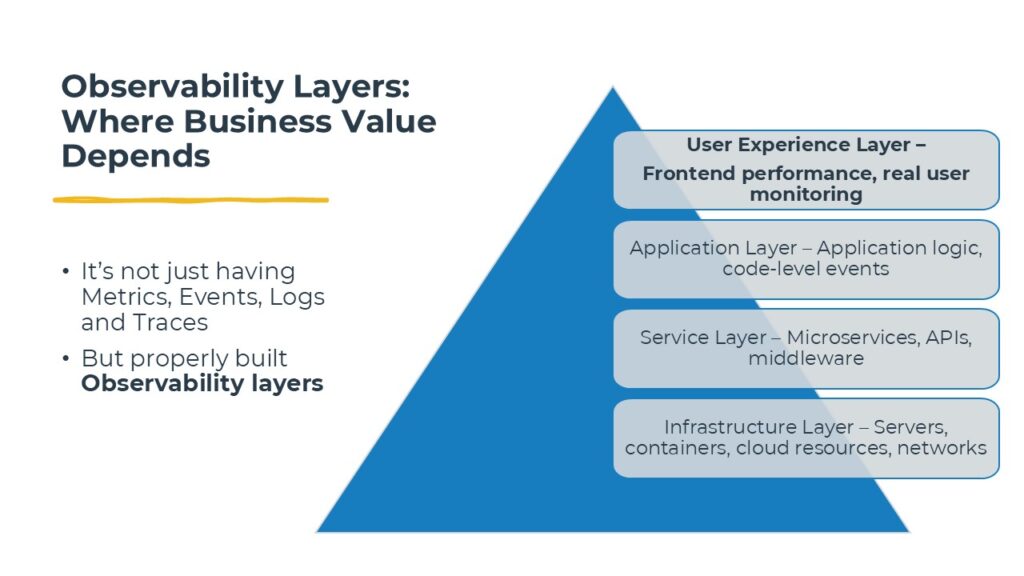
Telemetry alone is not observability. Metrics, logs, traces, and events are raw signals. Business value depends on how these signals are structured, correlated, and interpreted across layers.
- Infrastructure layer: Servers, containers, cloud resources, and networks form the foundation. Without reliable infrastructure telemetry, higher‑level insights quickly become unstable.
- Service layer: Microservices, APIs, and middleware expose dependencies and failure propagation. This layer explains how issues spread across systems.
- Application layer: Application logic and code‑level events reveal behaviour at the point where business logic actually executes.
- User experience layer: Frontend performance and real user monitoring connect everything back to real customer experience.
Want to Bring This Into Your Organization?
Turn these insights into practical, team‑level knowledge with our corporate trainings.
Designed for real business challenges, our sessions help teams better understand and handle complex system behavior.
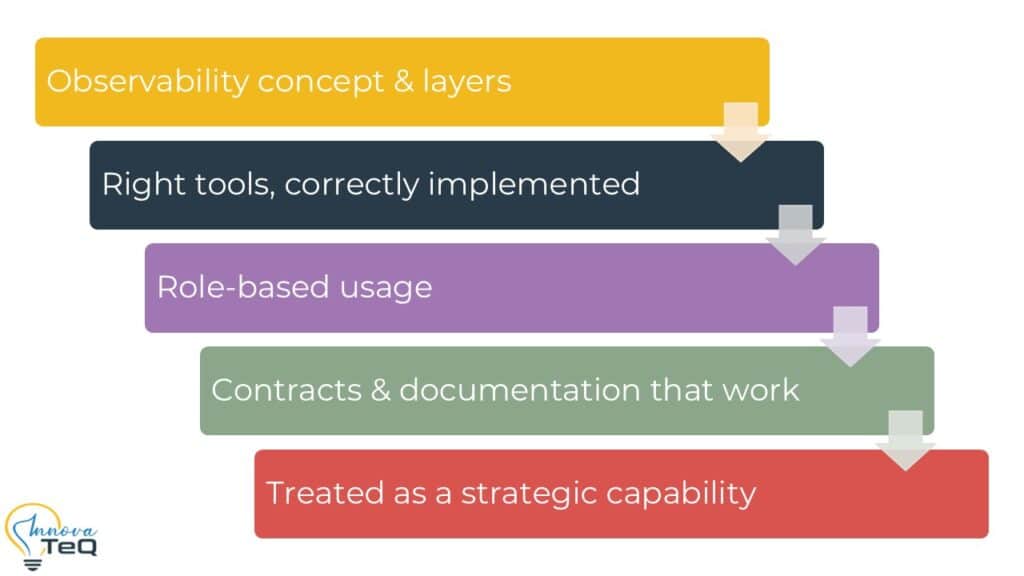
From Capability to Business Value: The 5 Building Blocks
Based on what I have repeatedly seen in client environments, the following five building blocks are critical if observability is to support real business value — not just technical insight.
1. A Clear Observability Concept and Layered Model
2. The Right Tools, Correctly Implemented
3. Role‑Based Usage Across the Organisation
4. Clear and Enforceable Conditions
5. Treated as a Strategic Company Capability
When the Missing Piece Is Small but Critical
In practice, creating business value from observability is rarely about throwing everything away and starting again. Much more often, organisations are already close — and what blocks real value is one or two small but critical gaps.
- A layer in the observability pyramid that quietly breaks trust.
- A role that has data but no mandate to interpret business impact.
- Signals that exist but are not trusted enough to support decisions.
- Insights that cannot trigger action due to missing conditions or ownership.