
The 5 Building Blocks of Business Observability That Create Real Business Value

by | May 7, 2026 | Business mindset, Observability, Strategy

Why Observability Often Fails to Create Business Value - Even When the Tools Are in Place

Business observability is one of those concepts that sounds immediately compelling.

Real‑time insights. Faster decisions. Clear visibility into how technical issues affect revenue, customers, and critical business flows. Finally, a shared language between IT and the business.
At least, that is the promise we keep hearing.
And yet, in real enterprise environments, this promise often breaks down. Dashboards exist, metrics flow, alerts fire — but trust is missing. Business leaders still ask the same familiar questions: What does this mean for us? Why did this happen? What should we do differently?
The gap between telemetry data and business value is rarely caused by a lack of data. In most organisations, the value is already there. What is missing is the capability to frame technical signals in a way that reliably supports business decisions.
Global view of interconnected systems representing business observability and the creation of real business value from telemetry data

What Is The Business Value of Observability?

In this context, Business Observability means the organisational capability to consistently connect technical telemetry to business decisions — across systems, teams, and layers.
Business Observability is often described as a “top layer”. In practice, it is something else entirely. It is a company‑level capability that only works if every underlying layer is built properly and the entire observability pyramid holds together. When any layer is weak, higher‑level insights become fragile, misleading, or simply untrusted.
This article focuses on what business value really means in the context of observability, and introduces five building blocks that I have consistently seen — across real client work — as essential for turning observability into genuine business value.

Subscribe to Our Newsletter

Get practical insights, case studies and learning opportunities directly to your inbox once a month.


The Promise and Why It Often Fails

The common narrative around business observability sounds convincing:

  • Faster decision‑making
  • Clear business impact of technical issues
  • Alignment between business and IT
  • Actionable, real‑time insights
In controlled demos, this promise seems easy to fulfil. Data is clean. Flows are simple. There is usually one happy path. Correlations appear obvious, dashboards look elegant, and insights feel immediate.
Enterprise reality is different.
Production systems are complex, distributed, and owned by multiple teams. Telemetry is partial, inconsistent, and often collected for different purposes. Metrics conflict, correlations mislead, and ownership is fragmented. The result is predictable: dashboards exist — but confidence does not.
This is the sandbox vs. reality gap, and it is the first reason why many observability initiatives struggle to create business value.

Business Value Goes Beyond Dashboards

One of the most damaging misconceptions around observability is the idea that value comes from dashboards themselves.

Dashboards are outputs, not outcomes.
Real business value emerges when technical data can be translated into:
  • cost implications,
  • revenue impact,
  • customer experience consequences,
  • and risks to critical business flows.
When done properly, business observability helps organisations protect revenue‑generating transactions, improve the reliability of critical flows, strengthen SLA compliance, and enable multiple roles to act on the same signals. The value multiplies because decisions become aligned across teams.
This only works if observability is treated as a capability, not as a reporting or visualisation layer.

Observability Depends on the Whole Pyramid
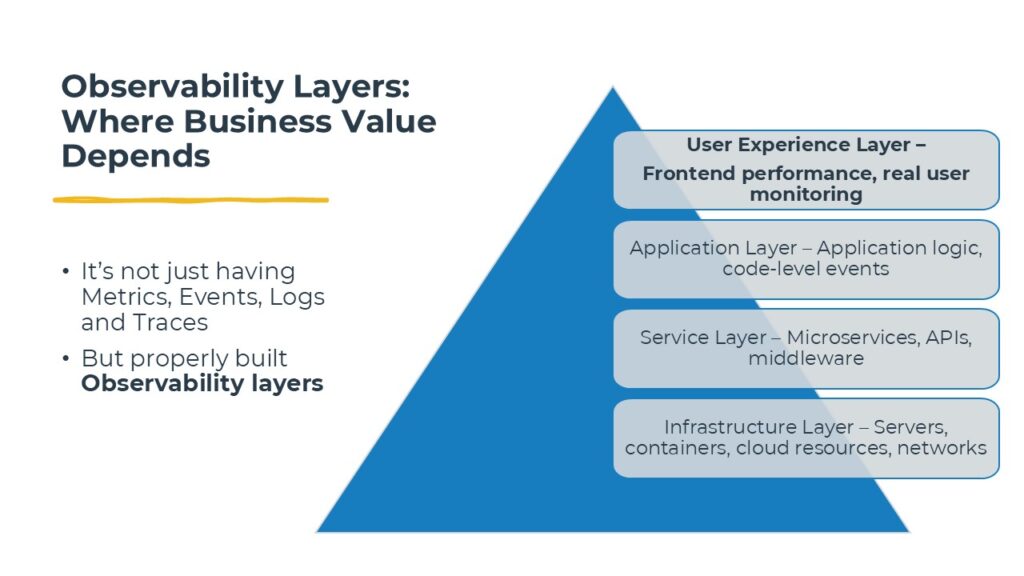
Observability layers pyramid showing how business value depends on infrastructure, service, application and user experience layers

Telemetry alone is not observability. Metrics, logs, traces, and events are raw signals. Business value depends on how these signals are structured, correlated, and interpreted across layers.

Each layer adds essential context:
  • Infrastructure layer: Servers, containers, cloud resources, and networks form the foundation. Without reliable infrastructure telemetry, higher‑level insights quickly become unstable.
  • Service layer: Microservices, APIs, and middleware expose dependencies and failure propagation. This layer explains how issues spread across systems.
  • Application layer: Application logic and code‑level events reveal behaviour at the point where business logic actually executes.
  • User experience layer: Frontend performance and real user monitoring connect everything back to real customer experience.
Business Observability does not sit above these layers. It depends on all of them being consistently observable and meaningfully connected. Skipping layers or treating them in isolation inevitably leads to misleading conclusions.

Want to Bring This Into Your Organization?

Turn these insights into practical, team‑level knowledge with our corporate trainings.
Designed for real business challenges, our sessions help teams better understand and handle complex system behavior.

From Capability to Business Value: The 5 Building Blocks

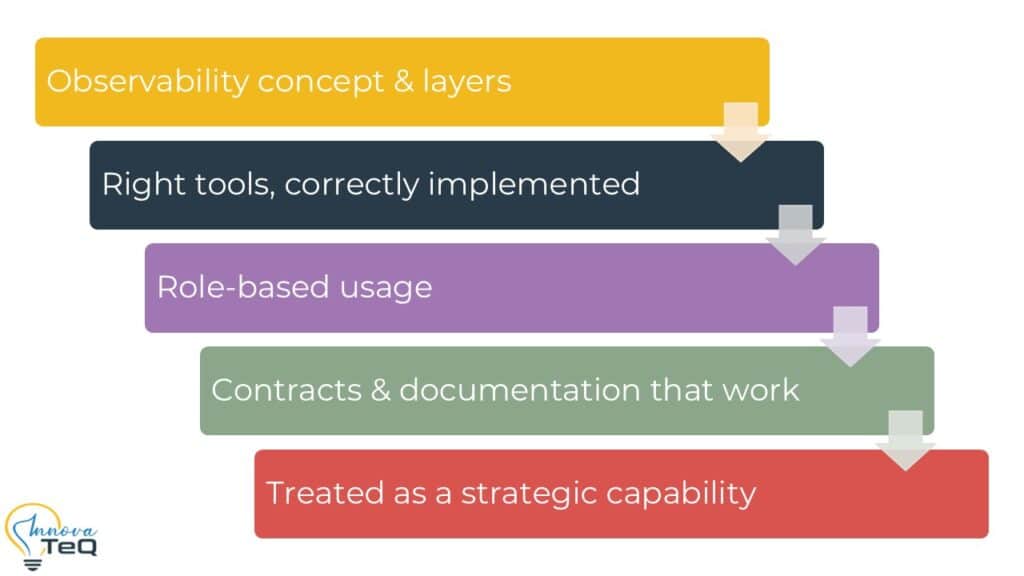
Based on what I have repeatedly seen in client environments, the following five building blocks are critical if observability is to support real business value — not just technical insight.

1. A Clear Observability Concept and Layered Model

If an organisation cannot clearly explain what “good observability” means, it will generate activity without outcomes.
A usable concept includes a shared layered model, clear expectations for each layer, explicit links to business flows, and a maturity view that explains what improvement actually means. Without this, teams optimise locally while business questions remain unanswered.


2. The Right Tools, Correctly Implemented

Tools matter, but they are never the strategy.
Correct implementation means enforced telemetry standards, reliable correlation across layers, and the ability to carry business context through technical signals. The goal is not to collect everything, but to collect what is needed — at sufficient quality — to support decisions.


3. Role‑Based Usage Across the Organisation

Observability creates business value only when it is usable by the roles that make decisions.
Engineers, SREs, platform teams, product owners, and business stakeholders all interact with observability differently. When observability remains “an engineering dashboard”, its value stays local. When multiple roles act on the same trusted signals, value multiplies.


4. Clear and Enforceable Conditions

Measurement alone does not change behaviour.
For insights to drive action, organisations need implementable SLAs, clear ownership, real consequences, and documentation that enables consistent interpretation. Availability without accountability is just a number.


5. Treated as a Strategic Company Capability
If observability is treated as a project, it will degrade.
Business Observability only becomes sustainable when it is owned at company level, embedded in governance, prioritised as a business risk and performance lever, and measured by outcomes — not by dashboard counts.
The five building blocks of business observability required to create real business value across observability layers

When the Missing Piece Is Small but Critical

In practice, creating business value from observability is rarely about throwing everything away and starting again. Much more often, organisations are already close — and what blocks real value is one or two small but critical gaps.

Typical patterns include:
  • A layer in the observability pyramid that quietly breaks trust.
  • A role that has data but no mandate to interpret business impact.
  • Signals that exist but are not trusted enough to support decisions.
  • Insights that cannot trigger action due to missing conditions or ownership.
The five building blocks above help make these gaps visible. In many cases, creating business value does not require new tools or radical change — but deliberate alignment that allows existing telemetry, processes, and people to finally connect.
If you want to explore this capability‑focused perspective further, we dive deeper into these building blocks and their practical application in our Business Observability and Observability Strategy trainings, with a focus on maturity, roles, and real enterprise scenarios rather than tools alone.

Enjoyed this article?

Discover our E-Learnings and corporate trainings!