
Why Communication Shapes Most Performance Outcomes
In modern software development, performance issues rarely originate from bad code alone. More often, they emerge from misaligned expectations, incomplete information flow, and teams working in isolation.
Effective communication in performance engineering can improve the efficiency of requirement clarifications or root cause analysis.
This article walks through a typical case, showing why communication is one of the most underrated yet essential skills in performance engineering and how a single conversation can unblock weeks of technical frustration.

Result of a Missing Performance Requirement
Imagine spending months or even years building a complex enterprise system, coordinating multiple vendors, teams, and technologies. Everything finally comes together at the integration phase. The moment when everyone, including the client, sees the full system running end‑to‑end for the first time. And then reality hits: things don’t work quite the way everyone assumed they would. Performance issues appear where no one expected them, and teams quickly realize that isolated success doesn’t guarantee system‑level reliability.
The Problem No One Owned
During integration testing, a critical API began to time out consistently. Each team insisted they were right:
- The frontend + API vendor said everything passed internal tests.
- The backend operations team said no changes had been requested.
- Project management couldn’t identify an owner.
Everyone stayed inside their own delivery boundaries instead of focusing on the end-to-end behaviour of the system.
Stepping In as a Mediator
A performance engineer was brought into the project from another department, the first step was not to examine logs, dashboards, or traces. Instead, the engineer focused on people.
He approached the integration team and frontend team with clarity and neutrality, explaining that the goal was not to assign fault but to understand the issue from each perspective. This immediately reduced tension, as teams often feel examined when performance problems surface late in a project.
The same approach was taken with the backend operations team. By maintaining a neutral, non‑judgmental stance and a friendly environment was created. All teams felt comfortable sharing context that would never appear in monitoring tools.
Only after listening carefully to the different viewpoints did the full picture begin to emerge.
Subscribe to Our Newsletter
Get practical insights, case studies and learning opportunities directly to your inbox once a month.
Finding the Root Cause
The technical problem was straightforward:
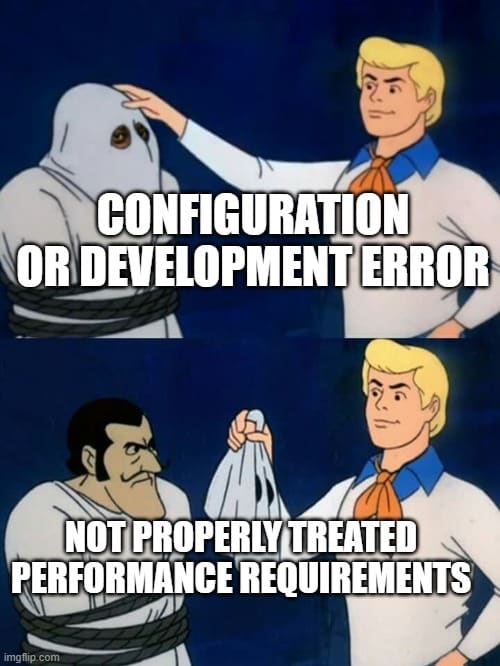
The frontend requested more data than the backend API had ever been designed to return within the expected time.
- This wasn’t a bug.
- It wasn’t a coding mistake.
- It was a design misalignment.
What was missing:
- shared performance requirements
- agreed data volume expectations
- clarity on system behaviour under realistic load
- joint design discussions early in the project
Individually, every component worked correctly.
Together, the system failed.
Turning Blame into Collaboration
Once the root cause became clear, discomfort naturally followed. Someone had to adjust their implementation, even though no one intentionally caused the issue.
Instead of letting frustration rise, the performance engineer offered to communicate the findings to leadership and explain that the issue came from a planning gap, not from negligence.
This reframing immediately shifted the atmosphere.
Teams moved from defensiveness to cooperation, and the fix was implemented smoothly.
Performance Engineering Lessons Learned
This story isn’t just about fixing a timeout error. It’s about the value of early communication, clearly defined performance requirements, and having someone who can bridge the gap between teams. Catching these issues early doesn’t just save money; it saves stress, preserves trust, and fosters a healthier working environment. Performance engineering is not only about systems behaving well; it’s about people working well together.
So next time you think performance engineering is just about tools and metrics, remember: sometimes, the most powerful tool is a conversation.